Race to Nowhere on iTunes nowApr 16, 2015I know I've mentioned the documentary Race to Nowhere before. Well it had been difficult to see. It is now available on iTunes. SEE IT! http://cts.vresp.com/c/?ReelLinkFilms/9eab551b87/7faf304769/cad088a78f/ign-mpt=uo%3D4
|
Spring Work Out TipsApr 14, 2015Exercise is the best natural way to produce both dopamine and serotonin. Translation: vigorous exercise directly improves attention and mood. Developing and maintaining an exercise routine is a topic that comes up with my coaching clients very often. Recently it has come up even more often. Perhaps it is our reaction to the horrendous winter we had here in Boston? Maybe it is just a general spring thing. But, everyone wants to get back to exercising. I am a person who doesn't not do well without exercise. Even though my hyperactivity is not as prominent as it was when I was younger, I still need to move. I have a hard time articulating the substantial benefits I get from working out 5-6 times a week. It can be difficult to quantify them. But, I will say this: If I can work out before I take the kids food shopping on Saturday mornings, the whole day goes better. The kids actually behave better. Why? Probably because I'm more focused, more patient, more flexible, more fun, and more centered. All from 30 min on the spin bike. So, here are a few quick tips on how to establish a work out routine and maintain it. (Unedited and in no particular order...) 1. Don't focus on the length of the work out at first. Just focus on doing it as often as you can. Once you take 2 days off... day 3 is really easy to skip. Even if it's only 10 minutes a day, try to establish a routine of at least 5 days a week. 2. Recognize your progress. This might seem like I'm say the opposite as no. 1, but... If you aren't working out now, even 2 days a week is a victory. 3. Really connect with why you are woking in. We tend not to do anything if we can't articulate and really believe it is worth it. So, what are you getting out of it?
For only 20 - 40 minutes a day you can have all of those things. That is a pretty great cost/benefit ratio. So, remind yourself out loud. "I will feel better and have better attention if I work out today." 4. Trust that you will work through the part that suck and makes you tired. If you can make it a routine, soon enough the work out will give you more energy and actually feel good. 5. Pick exercises that you want to do. Rock climbing, dancing, fencing, ultimate frisbee are all exercise. It doesn't have to be alone in an impersonal gym surrounded by meat heads. 6. Variety is the spice of life... and the best for your body. Mix it up. Keep the ADHD brain and the human body interested. 7. Stop when your body/mind tells you to. Don't push so hard that you leave your work out with a bad taste in your mouth. 30 minutes and a good feeling is better than 40 minutes and hating life. The former means you are more likely to go back tomorrow. 8. Just start and you'll be fine. Don't say, "I have to do 40 minutes or it's not worth it." That's a recipe for not working out at all. Just commit to 10 minutes. You'll probably do more. But, if you don't, it's still better than nothing, right? 9. Keep visual track of your progress. I like to keep a work out calendar. When I was first getting back into working out after years of being a miserable, overworked chef I would just put a big red X on a calendar on days I worked out. The X's really stand out and give you a sense of accomplishment. Helps build positive momentum.
|
Learning to regulate emotion and control angerApr 10, 2015So, I'm a bit behind in my blog entries. I have a list on my phone of things that I want to post about. It's about 30 items long. This particular one dates back to Mother's Day of last year. Better late than never. Actually the story starts on Christmas about 7 years ago. It was the first year I cooked Christmas dinner for the family. Bare in mind that I was a professional chef at the time. It was only five of us at that point. Then we were four. I think my mom was sick. I was making pollo al mattone. Chicken under a brick. It's an Italian classic that I'd made, literally, thousands of times, but never at home and not in a few years. I screwed it up and boned out the chicken wrong. As a result it wasn't cooking correctly or evenly. And it took me forever to realize why. I freaked out. I will spare you the details of the freak out, but it was ugly. It was the freak out that ruined the day for me, not the cooking mistake... I know this now, as I look back. And, it probably ruined it for everyone else too. Fast forward to Mother's Day last year, our first with two children. I was cooking a special clams dish for my wife (and brother-in-law) who love shellfish. For the rest of us, I was cooking with a special kind of black risotto rice my parents brought back from Italy. I had only read about this kind of rice. And, I went against my own advice and cooked something I wasn't familiar with for the first time on a special occasion. It was an absolute disaster. I'm not sure if the rice was old, or a joke they play on tourists, but I cooked it for about an hour (risotto should take about 25 minutes) and it was still hard, woody, and inedible. But I managed to not freak out this time. I just chalked it up to a learning experience and ordered pizza for me and my parents. And we had a lovely take out Mother's day on which we enjoyed each other's company and didn't have any freak outs. What I learned is that $#*! happens, whether it's my fault or not. Rolling with it is an adaptive live strategy. Freaking out about it doesn't help at all. Of course it took me into my mid thirties to figure this out... again, better late than never!
|
How Concerta worksApr 9, 2015
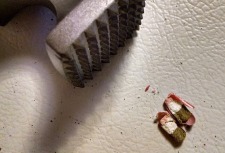
It also makes it much harder to abuse. I was told that if you smashed it, it would just goo-up because of the polymer. I didn't want to waste one, but accidentally dropped one in a puddle yesterday. So, I figured I'd hit is with a meat mallet and see what happened. Didn't goo-up, but pretty cool picture. You can pretty much see all the parts. One other interesting thing is that not all the med has time to be pushed out before it goes through you. That is why Concerta is dosed in weird multiples of 9. Some of it goes right through you... along with the barrel shaped capsule. Here's a link if you want more info: FDA Concerta Info
|
Paperwork strategies & Getting back on the horseApr 7, 2015
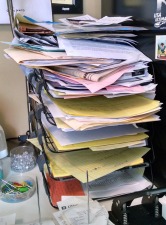
I have what I call "transitional areas." I have an "in box" that is my "to be filed" place. I usually go through it every month or two, or when it threatens to fall over. So, I eliminate the tedious, every day, grind of following through with the boring task of filing stuff away "in the moment." Instead it is a 20 minutes project that seems more efficient and can be undertaken at the time of my choosing when I feel like handling it. I guess I should have done a post just on that strategy. But, I'm posting today to both extoll the virtues of this strategy and talk about how it can be a trap is not followed up on. The attached picture is what my "in box" looked like until last Thursday. Turns out it had been about 5 months since I went through it. Yikes! It has been a brutal winter with all the snow, my wife working a lot, all of us getting sick multiple times, a now six-year-old, a just-turned-one-year-old, and major renovation project where the contractor really let me down. In other words... LIFE happened. The best thing I can say about this transitional space system is that we want all of our systems to continue to work even when the worst case scenario happens. Otherwise what good are they. Well, this system worked because it kept my desk and my office clean and organized for the five months. And, I got to that pile when I could. The one negative I will say is that I let it go so long that it was not longer a quick and easy 20 minutes. It was more like a detailed hour plus of filing, making new folders, and making decisions about what to keep. I guess the point is that it served its purpose, but I then had to engage some other strategies to get it done. I definitely realized that I got to a place where I was avoiding it because it had gotten bigger than I would have like. But, once I had that realization that I was sort of passively avoiding it, I took a more active approach and schedule specific time to take care of it. Two days later it was done. Now it's back to being filled back up. A good reminder that I need to address it more often if at all possible.
|
Know yourselfMar 20, 2015So... every two years I go to an ADHD conference through MGH. I'm currently waiting for the evening session to begin. "Assessment and Management of ADHD in College Students." I can't wait to share everything I'm learning. I'm sure there will be a series of entries on a variety of topics. Since I only have 5 minutes right now, I will share my strategies for surviving the conference itself as an ADHD adult.
Bottom line: these are the things I need to do to survive 12 hours of sitting still... even for a subject that interests me.
|
| page | 1 | 2 | 3 | 4 | 5 | 6 | 7 | 8 | 9 | 10 | next | previous |