Cult of the Curious?Mar 14, 2022Really quick one today. Y'all know that I don't do ANYTHING without music, podcast, sports, etc. As such, I like to share new podcasts that I get into. I recommend Time Suck with the comedian Dan Cummins. It's weird, a little dirty, funny, and very educational. He takes a deep dive researching some weird topic that used to be a "time suck" for him. Now he makes it a funny podcast and we all get to learn. Check it out... if you're over... 14... maybe.
|
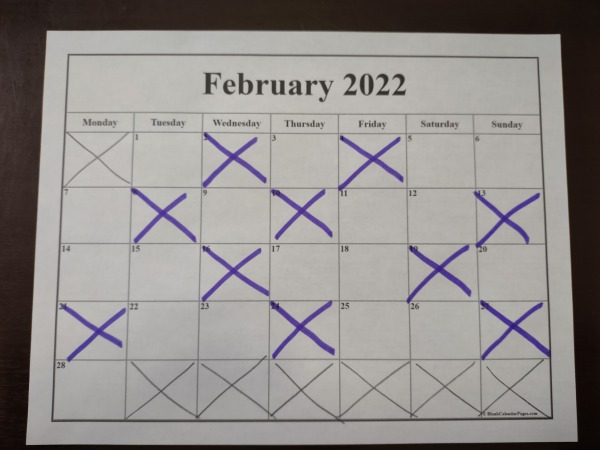
Adapt and overcome & Fitness Tip #1Mar 7, 2022I'm pretty sure that's the motto of the Navy Seals. I feel like we've all had to be special forces in one way or another in the past few years, especially as ADHDers. I've been adapting with my blog but not fast enough. As the peaks and valleys of the pandemic have rolled through, I've gone through times of pure survival and times of limited thriving. As I look back over my last few post, I looks like I did some straightforward topics but had the time to do some lengthy writing... then a month or so off. My goal has always been consistency. So, if I don't have the time to post longer form material, I want to be in touch with those of you who read the blog regularly. It may speak to my competence of ego that I feel I have enough to offer that I should be getting it out into the world, whether in larger chunks or smaller bits. For the near future, with birthdays, Bar Mitzvahs, vacations, anniversaries... and life on the horizon, I'm going to adapt and refocus yet again. I'm going to go back to shorter tips based posts for a little while. But I plan to post at least once a week, maybe even more. In fact, I've been doing a guest gig for a website with some fitness tips. Don't get jealous. I still love you guys the most. I my cross pollinate and share some of those here. As we know, exercise is one important piece of the puzzle in managing ADHD. It's not the biggest piece. I tend to think of it as about 15% or my ADHD management pie chart and closer to 25% or my Depression/Anxiety management pie chart. So, I think I'll try to drop some exercise nuggets every few days. We'll start with this one: Whenever you're trying to develop a new habit, routine, or behavior it can be really hard to start slowly. We tend to be all or nothing, black and white thinkers. But that way of thinking usually leads to unsustainable thought patterns and perceptions of failure even when we are succeeding. If you aren't working out at all, starting to get exercise 2-3 times a week is a huge victory. But without some concrete evidence or a very strict schedule, it can be hard to recognize and emotionally consolidate those gains. It is easy for it to "feel" like it's not enough. But many of us are visual creatures. I know I am. Inside my head is a scary place. It's like a funhouse mirror. Not much is accurately represented. But if I can get stuff out into the real world, where it is tangible, where I can see it, it becomes much more real. So, here's the tip. Print out a blank monthly calendar. Just put a big, fat, brightly colored X every day that you get exercise. It doesn't matter how much, what kind, or for how long. (And, this works for any behavior. It could be for a good eating day, going to bed on time, meditating, anything.) What may not have felt like a great week, or a great month, will likely be surprisingly inspiring when you actually look at it outside of your own recollection. I bet it will inspire you to continue at that level or even push you to do more. Either way, you are better off than you were before. Winning! I'll post an example of a personal who worked out 2-3 days a week on irregular days and simply kept track of having worked out with no more detail than that. That's an easy track record for an ADHDers to forget about or be discouraged by. But this picture/calendar looks pretty damn good to me. Makes me want to work out more! This person is a Winner! Happy Calendaring, The guy who's strangely confident in his calves... ... and the abs that he knows are somewhere under that inch of fat. Standard Disclaimer: In an effort to foil my own perfectionist tendencies, I do not edit my posts much… if at all. Please excuse and typ0s, Miss Steaks, grammatical errors, awkward phrasing. I focus on getting my content out. In my humble opinion, an imperfect post posted is infinitely better than a perfect post conceptualized but unfinished.
|
The power of persistence and calmFeb 10, 2022Quick nugget today. I haven't written much about my task management system, 10 steps to a badass To Do List because I consider it kind of a proprietary system that, once upon a time, pre pandemic, I was writing a book about. But there is one To Do List adjacent topic I want to discuss today, as it has cropped up in my life heavily in the last few weeks. Whatever your system is for keeping track of the things you need to get done, or if you don't have a system, those things probably cause you anxiety when there are a lot of them. And when we have anxiety about tasks we tend to avoid them. Of course that is a protective mechanism, psychologically. But it is maladaptive in terms of the overall outcome. I think it is really important to remember that the things we need to do actually exist in an objective reality. If we don't write them down or capture them somehow, they still exist. If we ignore them and play video games, they still exist. If we pretend to be productive by "keeping busy" doing unimportant things, the important stuff still exists. And my experience tells me that almost nothing ever gets better by ignoring it. Occasionally, we miss an opportunity to do something and it simply goes away. But that's not usually in a good way. Almost always things get worse when we ignore them... yet we do. I have found it helpful to accept that there will be feelings of being overwhelmed and being anxious. Those feelings aren't going to go away. They certainly aren't going to go away by avoiding things that are going to get worse and, therefore, more overwhelming and anxiety producing. We have to learn to sit with those feelings and engage in our task despite their presence. I've found that through is the only real way out. Each thing I check off the list, (like making a blog post,) the anxiety goes down and the feeling of accomplishment goes up. Eventually, I get out of the weeds and come to a clearing. Of course I have years of practice now. I have built a track record or success at the difficult but actionable behaviour pattern. So, for the last two weeks when, my printer, my bookkeeping system, my billing, my email host, etc. all went haywire at the same time and I had hours of extra work on top of my normal work and family stuff... I didn't lose my shit. I just put my head down and kept going. And, wouldn't you know, almost two weeks later, most of that stuff is taken care of. It required some extra hours and a little more stress than I would have liked. But staying calm and having a reasoned approach allowed me to make headway. Now I can see the clearing ahead. So if I could only get my ESPN+ to play last weekend's Dortmund game, life would be almost back to normal.
|
Back in survive mode?Feb 1, 2022It looks like I haven't posted since December 22nd. And, I will admit that that seems like a lifetime ago. This third wave, third variant, third winter, third strike, whatever you want to call it, has been hard on many of us. I'm not doing great. My clients aren't doing great. My kids aren't doing great. My friends aren't doing great. I really hope you are. But if you are, know that you are the outlyer. I've stopped playing the drums and stopped posting blog entries. That's one important thing from each half of my life that I just haven't had time for. They are similar in that they feel cumulative. What's the point of practice the drums once a week? And, what's the point of posting once a month? The drums... that's supposed to be fun. It's not feeling that way right now. So, I'm on hiatus. That's okay. I'm surviving. I'm putting most of my personal care time into an increased effort to work out and get back in shape now that my foot is healed. As for posting, that's not fun. It's work and it's important. And it's important to do it as often as I can and in whatever format I can. So, as I remind myself, I will remind you as well: now is a great time to reevaluate how much we have on our plate. What can we get rid of? What can we modify to make more manageable. How can we focus on what's really important. For me, in the context of my blogging, I think you can look forward to more regular, but briefer posts on topical stuff that I can bang out in fifteen minutes like this one. And, hopefully, that means you can read them in only a few minutes too. EVERYBODY WINS! It has been a long haul and it's not over. Stay strong. Get boosted. And balance your psychological well being with an acceptable amount of risk. Take care of yourselves.
|
Why MIND MAPS are the bomb!Dec 22, 2021It is no secret that ADHDers often have trouble with writing. But, as with most aspects of ADHD there is an element of counterintuitiveness with this struggle. Because this writing affliction strikes our population equally regardless of how well spoken and articulate we are. If you don’t understand how we’re wired, it will seem very strange that so many of us can speak clearly and articulately but when it comes to expressing our thoughts in writing we seem to lose our minds, get anxious, and can’t keep a linear train of thought. So what’s this all about? Since I have gone through this type of struggle myself and come out the other side, I’ve felt uniquely qualified to deconstruct my writing process in order to understand how I went from anxious, convoluted, and avoidant to confident, linear, and effective. As such, I’ve deconstructed my writing process to be able to teach it to other, similarly wired ADHDers. This is what I’ve learned about us… and writing in general. In order to write something good we have to do three things. We have to create content: ideas. We have to create structure: make it linear and understandable. And, we have to create language, craft the right words. Generally speaking, we as ADHDers, are pretty good at the first and the third things. But we struggle mightily with the structure part. Since organization is a core executive function and most of us struggle with executive functions in one way or another, this is a catch point. And, any topic of sufficient depth or complexity will require another key executive function, working memory, which is the ability to hold things in one’s mind and manipulate them. So, if you are sitting with a blank piece of paper or at a computer with nothing written and the cursor blinking at you, trying to hold all of your thoughts in your mind, move them around, organize them, have them come out in a meaningful order, while simultaneously creating language… and you have ADHD and executive function challenges… Good Luck! But that doesn't mean you can’t be a good or even a great writer. It just means you need a compensation strategy that works for how you are wired. What I figured out over the years is that two totally unrelated systems that I was taught about six years apart in school, that did work for me at all by themselves, worked great when I mashed them together. And in today’s world, the end result of that mashing can be done digitally with mind mapping software that saves time and gets great results. For me it started with what my third grade teacher called a spider-gram. I think most would recognize it as a circle in the middle of the page with the main idea, then lines going out from that main idea to supporting ideas in smaller circles around the page. This was great for getting my ideas out. But it didn’t really help me organize those ideas into a linear format. About six years, and many painful writing assignments later, I was introduced to the Harvard style outline. Many of you would be familiar with that as the standard style of taking notes where the biggest ideas are right up against the left margin, possibly with a Roman numeral. Smaller ideas are indented with letters, smaller ideas further indented with numbers perhaps, and so on. A great way to capture information and take notes. Very structured. But, if I could get stuff to come out of my brain like that, I wouldn’t need an outline. I’d just write the paper. So, what I figured out at some point in late high school or early college, (I can’t quite remember,) was that if you Voltron these two things together it works brilliantly. The first stage, the spider-gram is the first step of writing, creating the ideas. I usually don’t even fill in the connecting lines until I’m done making all the bubbles. I just want to “throw up” all my ideas as fast as I can before I forget them. Then I go back and cross out the duplicates, make the connections, nest the smaller ideas inside the bigger ones, and so one. Then I move on to the second step of writing. And, this is the most important point of all. This is where I isolate the part that is hardest for me/us, the structure. Back in the day, pre mind mapping software, I would go through the spider-gram and number all the “big idea” bubbles and put them in order. And at this point I’d have a really good idea of whether or not there were any holes in the proving of my thesis/point and it would be easy to fill in the needed extra bubbles. And, as if to prove the fact that I couldn’t do this without the “outline,” there was not a single time I did this that I rolled through this process and numbered the bubbles in order correctly. Invariably, I would end up realizing that I missed a key one and would have to renumber two or three times. But renumbering takes a minute. Rewriting multiple paragraphs or reworking the whole paper in the editing process could take hours… and attention that we don’t have. So, still back in the day, I would take this numbered spider-gram and translate it into a Harvard style outline. Content: done. Structure: done. All I had to do was sit at the computer and express myself in words, creating language - a thing I enjoy - while rolling down my outline. In. Order. That is when writing became easy for me. Fast forward to the 2010’s and mind maps and brain frames are all the rage in educational circles. But I think they are often misused. Teachers are so desperate to give kids a structure that they don’t understand separation of the steps and why that’s so important. They start by giving their students a very structured and, frankly, limiting “brain frame.” That doesn’t always help without the brainstorming process first. But, also with the 2010’s came an explosion of mind mapping software. You can get super fancy and spend lots of money on team friendly software or you can use free open source stuff. My recommendation is to go to the middle ground. I have found that the expensive stuff is great, but not worth the money and has bells and whistles that I don’t need. And the free stuff is too much of a pain in the ass to use. Because we know, if it’s not easy to use, we won’t use it. I use MindMiester, the Chrome extension. I also recommend Mindomo. They both let you do a few maps for free. Then the yearly fees are very reasonable. They both have stuff that I find annoying but they work well enough to get it done for what I’m talking about here. And, what I’m talking about here is modern efficiency! Instead of having to do the old school two step process, with the software, you can really cut it down to a quick one-and-a-half steps. You make your bubbles. I suggest starting with all “floating topics''.” Just like it was handwritten. Connect them after. Then you can drag them, move them, edit, next add, delete, link quotes, put in a turn of phrase you want to use in the final paper, and even footnote. That becomes the equivalent of your Harvard style outline without having to number anything or copy anything over. Just fill in any holes and Bob’s your uncle! You work from that reorganized and fortified mind map and that paper will flow out of your brain like nothing before. You’ll be able to do it easier, earlier, with less anxiety. It will be better. It will be faster, even taking into account the time you spent on the mind map. You won’t need to run on adrenaline to get it done. And the editing process will be almost nonexistent. You’ll be looking for typos and small improvements. You won’t need to rework massive sections of the paper. (As a side note, this is why I don’t really believe in assigning 1st drafts. I think that if you do the prep work right, by the time you start writing, it should be pretty close to a final draft.) The last thing I’ll say is that this is also a prime example of an external structure that we can internalize with time. Yes, I still use mind maps when I am writing something super complex, really long, or that I’m very emotional about. But, for the most part, I have internalized the ability to organize my thoughts for short to medium sized projects… like my blog posts. I do make a big deal about my disclaimer at the bottom of my posts. I know that I could go back and reread this post that is now over two pages single spaced and find some ways to make it better, more linear, tighter. But I also know that I’ve taught myself to be a good enough writer through the method mentioned above that this will be pretty darn good. It will be good enough that my ideas/ my content will shine through without any small mistakes of structure getting in the way. Not only am I really proud of that. But I think it should be an example that anyone can get here. Develop the tool. You will always have it in your toolbox when needed, and you may need it less and less over time. That sounds like a win/win to me. On a personal note, I was down with the flu for a week then got my booster and we are rolling into the holidays. So, this is likely my only post for several weeks in December. I’ll catch you all again in 2022. But I do want to thank my small but loyal group of readers. The occasional new subscriber and positive feedback I get from my thoughts, advice, musings and whatnot, help sustain me through the year. 2021 has been rough. But it was definitely better than 2020. Here’s to hoping 2022 is even better. Standard Disclaimer: In an effort to foil my own perfectionist tendencies, I do not edit my posts much… if at all. Please excuse and typ0s, Miss Steaks, grammatical errors, awkward phrasing. I focus on getting my content out. In my humble opinion, an imperfect post posted is infinitely better than a perfect post conceptualized but unfinished.
|
"To err is human; to forgive, divine." Especially one's self.Nov 20, 2021I added the last part. And, I'll get to that. But I always thought that the first part was Shakespeare. Turns out, not so. It was most notably used by Alexander Pope, English poet and essayist in the early 18th century. But it roots may go back as for as Plutarch. (Thanks Gramarist.com.) But leave it to an ADHDer to start his post with a digression. My kids are pharmacologically... complicated. I do the Dr.'s appointments and run point on the meds, partly because being the "primary parent" is my role in the family and partly because that's kind of my area of expertise. Well, it's my area adjacent. So I know a lot about pharmacology. Not counting the one of every fourth week when I fill all of my pill containers for the whole month, I fill all my kids weekly containers on Saturdays. Depending on what they are currently on, if I'm packing stuff to drop off at school, that can be up to eight different weekly pill boxes plus four bottles to go to two different schools. Lately, we've been weening one of our boys off several meds that haven't been working and may be making things worse. That's a slow, multi-week process. And, our other boy is experimenting with some different stuff that we are trying to manage week to week as we judge the short term ramifications. I only give you this background to illustrate that over the last 6 weeks or so, I don't think the kids have had their pill boxes fill the same two weeks in a row once. I know what I'm doing. I know the plan. All the boxes are in some way color-coded or labeled and when it gets really, really complicated, I take notes from our doctor's appointments, just to make sure I'm on the right page. But it is still a massive amount of detailed stuff to not make a single mistake... ever. I take it very seriously and I don't make them often. (And, the kids are really great. They usually ask if something is different in the pill boxes. Even if a generic changes shape of color, they check in to make sure everything is correct. But there have been so many changes lately, that they've taken to just trusting I'm doing the right thing.) Well, last week I made a mistake. I put the evening pills for the two kids in the wrong pill boxes. The share the major nighttime pill in common. So it wasn't the biggest deal. But it did mean that my oldest got a few fewer days of weaning off one his SSRI, and didn't get enough melatonin one night. And, it meant that my youngest got an unexpected very small dose of his brother's old SSRI for the week. Not that this makes my rather large mistake any better, but it may have been a happy accident. And, we may have figured out something about my youngest. But the jury is still out. Here's my point, as I have continued to bury the lead. This is a thing that is really important. This is a thing that I devote time, energy, and my best attention to. And, I still made a mistake. There was a time in my life that I would have let this strike me to the bone. I would have taken it personally. I would have connected it to every moment of inattention in my life, every mistake. I would have blown it out of proportion and let it derail me completely. I'm pretty glad that I've done the work on my ADHD to be where I am right now. It wasn't an ADHD/attention mistake. It was a human being mistake. So I'm also glad that I've done the work to allow my sense of identity catch up to who I really am. I'm not the late, unprepared, inattentive-mistake, fuck up that I was 20 years ago. I just human-person who makes human-person mistakes once in a while, especially when overwhelmed by caring for two kids with really intense needs. Perhaps the most beautiful part is that letting it go means I'm not carrying the baggage that would get into my head and make it more likely for something like this to happen again. I wasn't nervous filling the pill containers this week. I was extra careful. But not anxious in a way that would make another mistake more likely. So, maybe don't be too hard on yourself either? Standard Disclaimer: In an effort to foil my own perfectionist tendencies, I do not edit my posts much… if at all. Please excuse and typ0s, Miss Steaks, grammatical errors, awkward phrasing. I focus on getting my content out. In my humble opinion, an imperfect post posted is infinitely better than a perfect post conceptualized but unfinished.
|
| page | 1 | 2 | 3 | 4 | 5 | 6 | 7 | 8 | 9 | 10 | next | previous |