MGH PFACJan 20, 2015As of tonight, I am officially a member of the MGH Patients and Families Advisor Council. I'm super excited to be on this council and help make policy for one the best hospitals in the world. Apparently, there is much strategic planning and HIPA related stuff. So I may not be able to share too much, but I will do my best to keep everyone updated on what I can share.
|
Parenting Hotline & Other ResourcesDec 23, 2014I recently had a grandparent post on our CHADD website about... let's say overwhelming stress while managing her ADHD grandchild. I'm sure many parents/ care givers end up in a similar place. I wanted to pass along two resources I've become aware of. If you are worried about losing control with your kids... Parental Stress line: 800-632-8188 or www.parentshelpingparents.org And, if you are worried about you... Samaritans: 877-870-4673 The courageous thing to do is ask for help.
|
To Do List: the exception to the ruleDec 19, 2014So, I can't give all my secrets away on my blog, but... There are three things we need to manage to be successful human beings. As ADHDers we may struggle with all three. They are Tasks, Time & Stuff. I'll speak to managing task for a minute now. The best way I have found to manage tasks for us to a "simple" To Do List. However that list is not so simple. By my count there are 10 specific aspect to a really great and useful TDL. I'll talk a little about one today. The idea is to have one master list for things to get done in your personal life and one master list of things to get done at work/school. I usually talk to clients for about 10 minutes about this aspect of the List and explore it pretty good depth. However, today I'm going to talk about the exception to the rule. When we have one huge project with many moving parts or many sub-tasks it is usually better to create a side list. (The is the advanced lesson for most, once they TDL basics are mostly mastered.) I thought to mention this today, because I have a big project in my house. Since our second was born in April, the basement has been a $#!% storm of old baby stuff, new baby stuff, hand me downs, donations, etc. Not to mention my tools... As a professional organizer, it is the one place in my life, I'd be afraid to let a client see. And it really bugs me because the ease of finding what I need has decreased radically. I went down the other day to game plan. I will admit I was overwhelmed. So, I picked one small aspect of the room and tackled that, then another small aspect. 2 hours later, those two areas were squared away... and the rest looked worse. But it was definitive progress. Now I'm left with "what's next," and some of that overwhelmed feeling remaining. So, I made a list by breaking the basement down in to as many sub tasks as possible. (Chunking like that is also one of the ten points of the amazing TDL!) But, the basement job isn't a high priority, even though it annoys the heck out of me. And, even if it were, the 20 tasks generated on the list would overwhelm my TDL and freak me out, affecting my overall productivity. So I simply started a basement list. And, when I get to it, I get to it. But, I'm not stressed out about it anymore and I have clearly defined smaller pieces to work on when I can. The idea of the, let's call it a "spinoff list," is to make a supplementary list containing tasks or items for a very specific large task. Probably, you would still leave "organize basement" on your Master TDL. So you would see it when you checked your list, but only have to look at the sub tasks when you had time to go down there and work. I think the best analogy is to a grocery list. Go Food Shopping should be on your MTDL, but you aren't writing every banana that you need on the Master. That's what the shopping list. This technique was particularly helpful to me when we bought a house and moved in less than two month. I worked great when I coordinated many separate professionals when we had the back yard redone after moving. And, now it's in play for the basement. As per usual, I don't plan to edit this. Consider my mistakes an ADHD victory. If I committed to writing, editing, rewriting, etc., I'd never post anything... Today: Me - 1 ADHD - 0
|
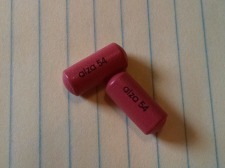
Import Generic Concerta InformationDec 12, 2014If you or your child takes a generic type of Concerta you need to read this: If you don't know what generics are, please check out two posts ago for the basics.
|
Teaching sequencingDec 12, 2014
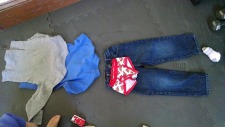
Many ADHD children struggle with getting up to speed in terms of executing regular every day correctly. I find this particularly applies to handling the morning and evening routines. I don't know if my five year old has ADHD or not, but I often realize that I am teaching him things in a way that would work for me. (I think there is an older post about how I give our weekend structure by letting him know what's coming next.) Another way that I realize I have taught him something by giving it structure is getting dressed independently in the morning. As soon as he was old enough to get dressed on his own (with supervision,) I started laying his clothes out the way you see in the picture. That taught him the right order of putting stuff on. Now (on his cooperative days) he can go in to his room pick out his outfit and get dressed completely on his own. Of course this isn't every day and sometime it seems to take him 3 hours to do it. But we haven't had any days where he comes down with his undies on the outside on not wearing any at all. I'd say that's pretty good!
|
Generic Medication PrimerDec 12, 2014
It often cost hundreds of millions of dollars to develop a new drug. As a result, new drugs are protected from competition for a period of time after development. (Currently 12 years.) They are the only game in town and the company who owns the patent can charge top dollar to make back the investment they made developing the drug. Once that period of time expires other companies are permitted to offer competing "generic" drugs that are deemed equivalent to the original. Those generic drugs are required to have the same active ingredients and be "bioequivilent" to the original, meaning that that active ingredient is delivered and works in the same way. I will tell you from personal experience that this is not always exactly true. I respond differently to some generics versus the name brand original and in some cases I respond differently to the generics made by different companies. This can present a problem for many of us. The insurance companies don't recognize that the generics don't always work the same. In fact, pharmacies are mandated to substitute a generic when available unless the doctor specifically writes "no substitution" on the prescription. In the larger picture this makes sense and helps keep our healthcare cost down. Though, in many cases, even with the doctors authorization the name brand will be prohibitively more expensive. In fact, there is one medication that I take to counteract stimulant induced insomnia that the insurance won't cover at all, even at a tier 3 price. Luckily there is one generic that works pretty well and I can have my pharmacist get it. So, you're not necessarily crazy if you think your generic doesn't quite feel like the original, or you don't think it is working quite the same since it "changed" shape and color. (When you pharmacy changed producer.) Don't be afraid to ask if they can get a different producer, or change pharmacies if they can't. It's your body. Be confident in what's going in it.
|
| page | 1 | 2 | 3 | 4 | 5 | 6 | 7 | 8 | 9 | 10 | next | previous |